
Hey Bowlers,
I have been asked over the past several years about a bowlers RPM. You all hear that mentioned on PBA telecasts. And, I’m guessing a bit, have heard some of your fellow league bowlers talk about the “reves” they are imparting on their ball!
This post is intended to clarify what this all actually means. For instance, do you think if you have a rev rate of 400 rpm your ball is rotating 400 times when it goes down the lane? Or maybe you think when you see your multi-colored pearl reactive resin bowling ball rolling down the lane that sucker is spinning for all it’s worth!
I’m not going to bore you with graphs and complicated geometry. This post will be to the point and pretty straight forward. Before I go into the math (yes there is a little math involved – just multiplying and dividing – you remeber that!) a little history is in order.
Prior to the “rev rate” revolution, when you were coached or went to a training center; usually they would video you throwing a ball. The coach would put some white tape on the ball before you rolled it. Then you would sit down with the coach and watch the video. The way they evaluated your potential scoring capacity was to count the number of times that piece of tape would make a full revolution. In those days there were charts to compare the number of rotations to rpm and scoring potential!
The following chart is that kind of tool for you to use to evaluate your “rev rate” at a specific speed and time it takes the ball to travel 60 feet. What I think you may find interesting is what is actually happening in terms of the balls full rotations down a bowling lane.
Here are some givens to get the party started:
RPM = revolutions per minute. If you have a car with a tachometer (not the speed odmeter) this is telling you the number of times the engine is rotating in one minute. For our use we need to convert RPM to revolutions per second. Therefore (math term) one minute = 60 seconds. To convert the speed to RPS, we divide the total distance traveled in one hour (MPH is miles per hour). So, 14 MPH x 5280 feet in one mile divided by 3600 (60 mins x 60 secs) = 20.5 feet per second. So, the time to go 60 feet at 14 mph would be 2.92 seconds. Whew – I need a nap!
Here is how it works: if you have a rev rate of 300 rpm that would translate to: 300 rpm / 60 seconds = 5 rps. At 14 mph it takes the ball 2.92 seconds to hit the head pin. So, 2.92 seconds times 5 rps = 14.6 revolutions the ball would make before hitting the head pin; not 300! Kind of a suprize for some of you I’m sure! Keep that perspective when you bowl!
Below is a chart of revolutions on the vertical side and ball speed across the top. If you put a piece of tape perpindicular to the midline of your hand (I lied I guess there is some geometry!) you could have someone video the roll of your ball and count the number of full revolutions before it hits the head pin. You can use the chart to estimate your “rev rate” … like we did in the olden days. Enjoy!!
As you will see on the chart the kind of revolutions some of the pros are getting to get their ball to turn the corner!
The chart shows the number of full revolutions based on ball speed and rev rate. Everything to the right and below the red lines are the number of times the ball revolves going down the lane. If you know the number of revolutions your ball rotates going down the lane you can estimate ball speed and rev rate! Get those videos going!!
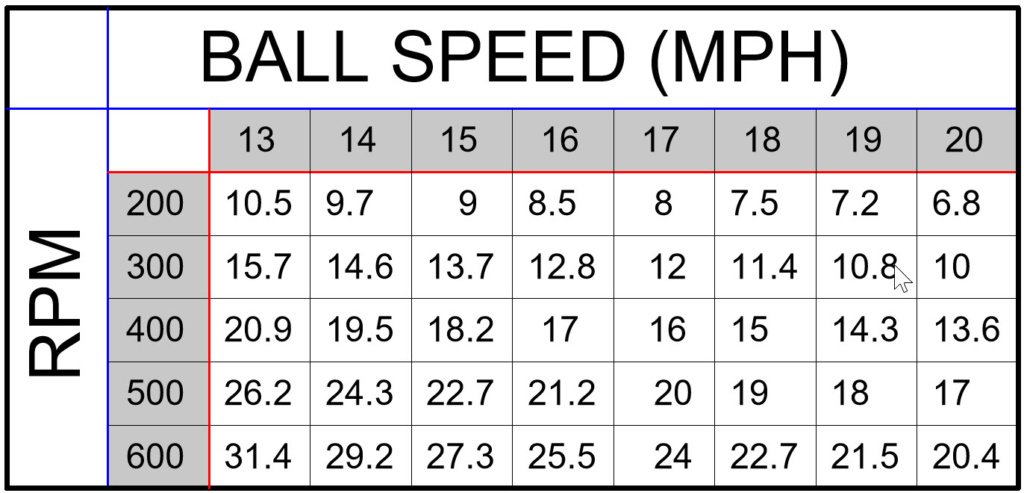
References you can use to evaluate your own speed / rev rates:
RPM converted to RPS
Time to go 60 feet at a given ball speed
When Osku Palermaa throws a spare ball at 35 MPH it is getting to the head pin in 1.17 seconds!! And as you can see in the chart speed and revolutions are related. 400 RPM at 13 MPH is most likely not a good combo. But 400 RPM at 18 MPH provides control a movement. And then there is accuracy. An issue for a nother discussion in the future.
Good bowling everyone ….